Utrecht, June 4, 2026 – The Global Feed LCA Institute (GFLI) participated in the multi-stakeholder dialogue “How to Build a Sustainable Bridge Between Feed and Food,” organized by GMP+. The event brought together stakeholders from across the feed and food industry to exchange insights and explore how both sectors can jointly move toward a more sustainable future for the animal-based product industry.
Increasing market demand from supply chain actors for reliable sustainability data on animal-based products is driving the need for robust environmental footprint (EF) calculations. However, the availability of high-quality, consistent data remains a challenge, complicating efforts to build robust datasets for calculating environmental footprint (EF). High-quality data for EF-calculations provides insight in the environmental impact of feed and allows companies to make more sustainable choices in their use of raw materials. Robust data for EF-calculation can be obtained if partners throughout the value chain collaborate with each other.
Collaboration across the supply chain
During the dialogue, participants emphasized that collaboration across the entire supply chain is essential to address these challenges. The sector can work towards generating more representative and reliable data for environmental footprint calculations by improving data availability and increasing transparency between supply chain partners.
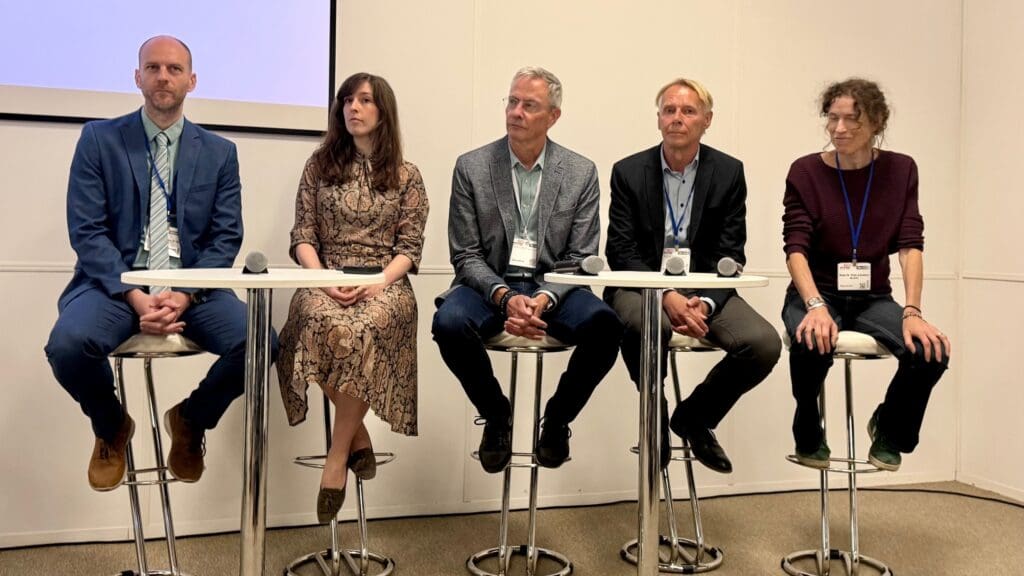
In a panel discussion between GFLI, WUR, ILVO, FEFAC and Trouw Nutrition, GFLI supported the importance of moving towards a uniform standard that can be applied consistently throughout the global supply chain.
Supermarket retailer Albert Heijn shared how their collaboration with the supply chain led to a reduction in carbon footprint emission of the supermarket retailer. Their presence during the dialogue shows how the downstream partners are also actively involved in reducing the EF of animal products.
Working towards a harmonised standard
GMP+ recently published the MI 5.7 Feed Life Cycle Assessment (LCA), enabling companies within the feed industry to calculate and report the EF of feed using an uniform method across the value chain. This standard improves transparency and supports sustainability goals. MI 5.7 recognises the GFLI database as a credible source for environmental footprint calculations. Companies can obtain certification under the MI 5.7 standard, thereby demonstrating that a harmonised methodology is applied in their EF calculations.
The event was both interactive and insightful. It reinforced the importance of establishing a harmonised methodology for environmental impact assessment and demonstrated the added value of bringing together all stakeholders in the value chain. The meeting marked another step forward in the ambition to build a future to create more sustainable animal products using an uniform method. GFLI has a critical role in the creation of a uniform method by providing a methodology and database ensuring all feed ingredients are calculated using a transparent and uniform method.