
Download the GFLI database from the website if you already have access, or request a license to get started today!
Thank you for your interest in the GFLI database. The newest database update contains some error correction, a revamp of the methodology and procedures document (now combined in one document) and some updates regarding both the methodology and procedures, and the integration of new ingredients and data projects completed in the last year. The new database contains 1920 ingredients from various regions. Read more about the update below!
Database update
A list of updates regarding the database are as follows:
- Error correction; some datasets had a mistake in the calculation of the Data Quality Rating (sources as noted in the database: AFIA, Feedgrade egg processing industries)
- The correction factors for peat oxidation modelling have been removed as it was based on relatively old and unspecific data. This means the default national calculations are upheld without a correction towards ingredients only produced in specific regions of the country. This is only applicable for the statistical data in the database.
- The database contains a column indicating the type of ingredient the dataset falls under. These will be streamlined in the next database update and may differ in naming.
- Datasets from the data source: AFP, now reflect the 5-year average of 2018-2022 through FAOstat (for yield data, manure, seed input, pesticides data, production statistics and trade data); and IFAstat data from synthetic fertilizer (consumption).
- Datasets from the data source: AFP, now also reflect a 3-year average between 2017 to 2021 for land use (change), as opposed to the previous 3-year average of 2014 to 2017.
- A couple of methodological aspects changed within these same AFP datasets related to water requirement ratios removed for irrigation and rainwater, individual EU country-level fertilizer data from the International Fertilizer Association (IFA), a crop system efficiency index implemented, & a heavy metal emissions methodological update. Details can be read here.
Impact of the update
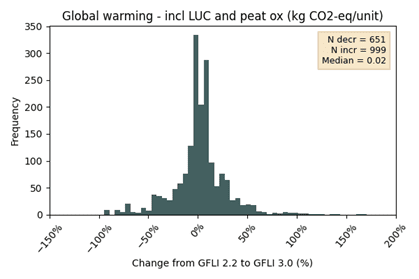
While the database changes are relatively minor, some impact can be observed within the AFP datasets due to the removal of the correction factors, slight shifts due to background data updates, and the beforementioned updated averages. See Figure 1 below of the relatively changes of total impact of the database.
New integrated datasets
In the GFLI database version 3.0, there are 11 new sectoral ingredients included (based on industry-sourced data), the integration of the higher tier modelled Brazilian data from the research institute Embrapa (from 2022), as well as the integration of the validated 60 branded (company-specific) ingredients during and beyond the GFLI branded data pilot.
Table 1. new ingredients integrated into the database
| Type of ingredients | # ingredients | Regional representation: | Data source |
| Pulse ingredients: peas & lentils, faba bean | 2 | Canada (Prairie region) | University of British Columbia |
| Cultivated ingredients and processed into silages | 7 | Denmark | SEGES Innovation |
| Former foodstuff (dried) | 1 | Belgium | Trotec |
| Nutritionally improved straw, processed cultivated ingredient | 1 | United Kingdom | Sundown Agri |
| A variety of ingredients presenting data from companies | 60 | Various | Branded data |
*Please note that the Data Quality Rating for projects are reflected towards the ‘publication year’. This means a DQR calculated in publication year 2021 would in reality have a higher (less favourable) DQR due to the 5 year time window.
Methodology update
With the database update, the methodology has also been updated and revised to reflect the latest technical updates. A major difference is that the new document now includes the methodology for regional and sectoral datasets, branded data, and also the procedures to conduct a data project. Some chapters have changed in layout, so it is recommended to have a look at the table of contents and reading guide to proceed.
Content-related changes:
- A glossary is included and a list of abbreviations added to clarify the terminology used in the document.
- Higher tier modelling is described on how an alternative from the baseline model may be approved through the GFLI technical management committee.
- Updates regarding the default modelling and approaches, which also includes an updated list of default allocation factors and updated pesticides approach.
- The procedures to do a data project (both sectoral and branded data) are further detailed with relevant information and combined in one chapter.
Relevant links
- See the full overview of the ingredients in the GFLI database
- Clarifications about the LCIA and the new update are also included in the updated LCIA guidance document
- Click here to access the updated database, then follow this webpage.
- Want access but haven’t got a license yet? Read this webpage & get in touch with us!
We welcome you to download and utilize the latest version of the GFLI database to reflect the industry standard to work with the latest available data available.
Next database update
If you followed the GFLI communications closely, you may see that some topics are missing in the current overview. As we proceed in 2026, GFLI will aim to include a FLAG-aligned version of the database and integrate a system to consistently name and number each unique dataset in the GFLI database hosted on GFLI’s own IT-platform. Stay tuned by signing up to the GFLI newsletter!
| Source | Information about the project | Reference year |
| AFP 7.0 | Datasets created through the GFLI default method of statistical and open source data (FAOstat 2018-2022), by Blonk Consultants. | 2022 |
| AFP additional | Datasets created through the GFLI default method of statistical and open source data (FAOstat production data from 2014-2018, FAOstat cultivation data from 2018-2022) that are currently not available in AFP, by Blonk Consultants. | 2022 |
| AFP – Nevedi | Datasets created conform the GFLI default method of statistical and open source data (FAOstat 2018-2022), by Blonk Consultants, funded by the Dutch Feed Association Nevedi. | 2022 |
| Branded data (Feb’22 pilot) | Datasets conform the GFLI branded data methodology from the pilot held between February 2022 to March 2023. This is company-specific ingredients based in part or wholly on primary data. | 2019 to 2023 |
| Branded data (Oct’23 V1 methodology) | Datasets conform the GFLI branded data methodology version 1, published October 2023 following the pilot of branded data. This is company-specific ingredients based in part or wholly on primary data. | Various |
| EAPA | Datasets created through industry data sourced from the European Animal Protein Association (EAPA) members. | 2018 |
| EFPRA | Datasets created through industry data sourced from the European Fat Processors and Renderers Association (EFPRA) members | 2021 |
| Feedgrade egg processing industries | Datasets created through industry data sourced from European egg processing industries. | 2023 |
| GFLI AFIA | Processed ingredients created through industry data and open source data, commissioned by the American Feed Industry Association (AFIA) | 2021 |
| GFLI BFAN | Datasets created through industry data sourced from the German Federal Association for By-Products as Animal Feed (BFaN) members | 2019 |
| GFLI Brazil | Datasets created through higher tier modelling sourced from the Brazilian Agricultural Research Corporation (Embrapa). | 2021 |
| GFLI Canada | Datasets created through industry data on cultivated ingredients and complemented by statistics from Statistics Canada for missing data, by ANAC | 2019 |
| GFLI group | Datasets created through averaging available data for the European region, sourced from the PEF screening study for feed (2018) | 2018 |
| totals | ||
| GFLI Wet-coproducts | Datasets created through industry data for the European region, sourced from Duynie Group | 2022 |
| Individual data projects | Dataset created through industry data for the processing, sourced from individual companies with a representative market share of the country in scope | 2024 |
| SEGES Innovation | Datasets created through regionalized statistical data from Denmark, sourced from SEGES Innovation | 2022 |
| UBC – Pulse Project | Datasets created through industry data surveyed by the University of Columbia for Pulse Canada (association) | 2020 |
| UKFFPA | Datasets created through industry data sourced from the Former Foodstuffs Association of the United Kingdom (UKFFPA) members. | 2019 |
| USDA | Created through statistical data from the USDA. | 2017 |